Map of Elephantine
new drawing by Sadie · landscape
The Island
Where Elephantine Is
Placeholder — where the island sits on the Nile, who lived there, and why it mattered as a border town and trading post.
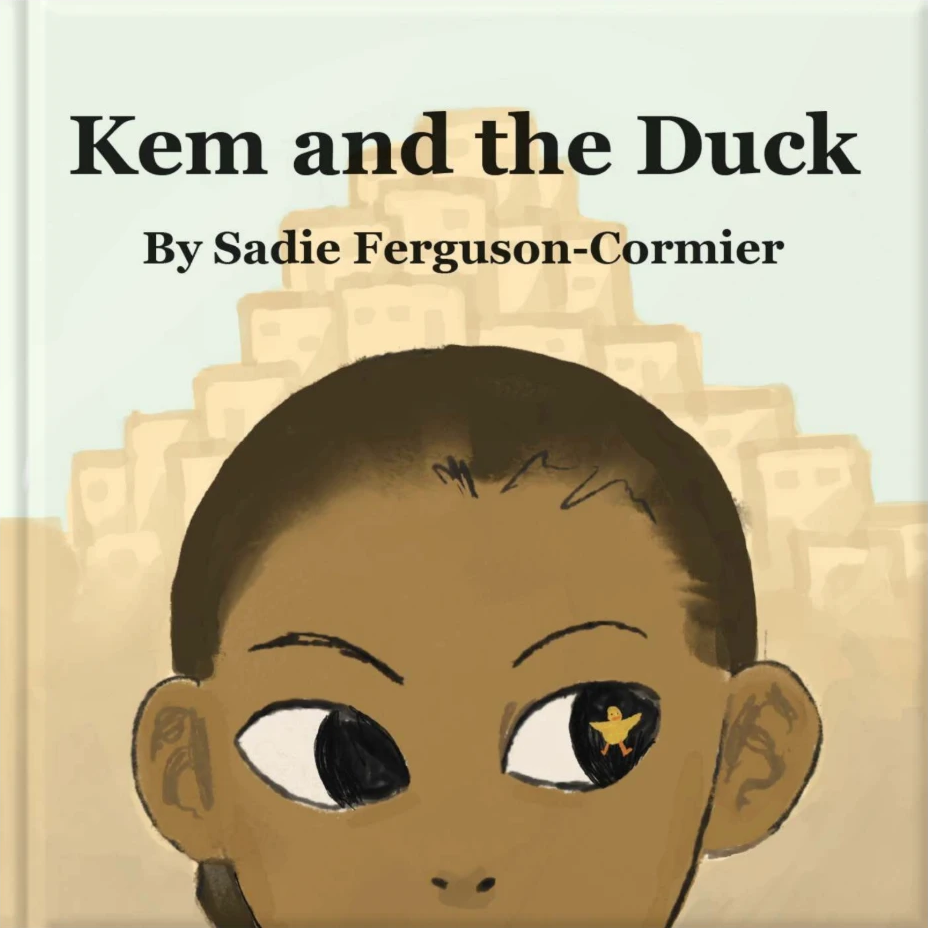
Placeholder — two or three sentences introducing the story and what this companion adds to it: the island Kem lives on, the papyri that tell us about it, and the person who wrote and drew the book.
Part One
Placeholder — one short paragraph on what the island was like when Kem lived there.
The Island
Placeholder — where the island sits on the Nile, who lived there, and why it mattered as a border town and trading post.
Inspiration • Setting
Kem and the Duck take place on the island of Elephantine in Old Kingdom Egypt (c. 2686–2181 BCE). Elephantine (known in ancient Egyptian as Abu, meaning “elephant” or “ivory”) was the southernmost frontier city on the First Cataract of the Nile, serving as the launching point for trade and military expeditions into Nubia. It functioned as a major hub for valuable southern goods, particularly ivory, gold, and exotic raw materials moving northward into Egypt. Elephantine was also the primary cult center for the local goddess Satis, whose name is derived from a root meaning “to pour” or “to shoot”, reflecting her status as a personification of the Nile inundation.
The Town
Placeholder — the workshops, the goods that changed hands, and how people paid for things.
Inspiration
Kem and the Duck was loosely inspired by the “letter from a son to his father”, a document from the Brooklyn papyri collection. The son wrote, “The son says before his father, who he loves: life, prosperity, and health! May Ptah, the one to the south of his wall, sweeten your heart with life, and may your beautiful Imakhu exist before the Ka of Neferkare.”
Ptah is the ancient Egyptian creator god, patron of craftsmen, architects, and artisans. Invoking the god was a standard blessing of happiness and prosperity.
Imakhu, often translated as Reverence or Venerated Status, refers to the state of being an honored, revered elder. This means that the son is praying that his father will enjoy a respectful old age.
Ka is the vital life force or spiritual double born in every human according to Egyptian religion. Neferkare is the throne name of the Pharaoh (most likely Pepi II Neferkare, who ruled during the Sixth Dynasty of the Old Kingdom). The phrase “may your beautiful Imhakhu exist before the Ka of Neferkare” is a wish that the father’s soul will be in the good graces of the divine King in the afterlife.
Part Two
The collection of papyri that includes the letter from a son to his father, which is the inspiration for Kem and the Duck, originates from the island of Elephantine near modern day Aswan, Egypt’s southern frontier administrative center. The papyri consists of a range of documents, including personal letters, household and temple accounts, and legal and administrative documents. Originating from the Late Old Kingdom of Ancient Egypt (about 2300 BCE), the papyri are the oldest Egyptian papyri in a North American Collection. They offer a rare look at provincial life and literacy far from the royal court.
Brooklyn Papyri
The papyri entered Western hands through the collection of American journalist and collector Charles Edwin Wilbour, who purchased them in the 1890s. Following Wilbour’s death, the collection was donated to the Brooklyn Museum in 1916. They remained largely unstudied and hidden from public view for about a century.
Carried
Placeholder — the journey from Egypt to the Brooklyn Museum, and the boxes of fragments that came with them. (Date shown is a draft for Sadie to confirm.)
Brooklyn Papyri
Beginning in 2022, Assistant Professor of Egyptology Victoria Almansa-Villatoro encountered the collection in the basement of the Brooklyn Museum. She spent several years photographing the thousands of fragments to ensure there was a record of them, and then began to read them—a challenging task, as the fragments are so small that only a bit of information can be gleaned from each one. Supported by conservation grants, the Brooklyn papyri went on public display for the first time in May 2026 at the Yale Peabody Museum in the exhibit Unfolding History: Writing in Ancient Egypt.

Author and Illustrator
Sadie Ferguson-Cormier is a Senior at Guilford High School and is graduating in 2027. She plans to study the humanities in college and is fascinated by language and linguistics.
She was inspired to write Kem and the Duck by her research internship for Yale Assistant Professor Almansa-Villatoro, under whom she worked to reconstruct the Brooklyn papyri through the use of AI tools.
Kem and the Duck is her first book.